
Check the list of previously requested streets for traffic calming in Whitby.
This page is under development
Traffic Calming
Traffic calming aims to improve road safety and enhance community livability by reducing the negative effects of motor vehicle use, altering driver behaviour, and improving conditions for pedestrians and cyclists.
When properly used, these Traffic Calming Measures can help reduce motor vehicle speeds, neighbourhood traffic infiltration, pedestrian crossing distances and times, conflicts between roadway users, and the risk and severity of motor vehicle collisions.
While offering potential benefits, some traffic calming measures can be costly and time-consuming to install. If used inappropriately, they may also increase emergency vehicle response and transit operating times, impede residents’ access to neighbourhoods, divert traffic problems to other roads, escalate costs for snow clearing, curbside waste collection, and other maintenance functions, and intensify vehicle emissions and/or noise pollution. Careful consideration and proper planning, including public support, help to ensure the successful implementation of traffic calming measures.
The Town follows its Traffic Calming Policy to evaluate and prioritize traffic calming requests. It is noted that only Local, Collector and Select Arterial Type C roads with posted speed limit of 50 km/h or less are eligible for traffic calming measures under the Town’s policy.
Traffic Calming Streets Requested for Review
Traffic Calming Projects Previously Completed or in Progress
Check the status of traffic calming projects in Whitby.
List of Existing Traffic Calmed Streets
Request (New) Traffic Calming in Your Neighbourhood
The Town follows its Traffic Calming Policy to evaluate and prioritize traffic calming requests. Only Local, Collector and Select Arterial Type C roads with posted speed limit of 50 km/h or less as are eligible for traffic calming measures under the Town’s policy. An overview of the process is provided in Appendix 2 of the Policy.
Step 1: Request
- Initiate the Traffic Calming Study process by submitting a request to the Town’s Transportation Services using the Traffic Calming Request Form.
- The Town will first consider the subject street and surrounding area for a 40 km/h Neighbourhood Speed Limit based on the criteria specified in the Policy.
Step 2: Initial Screening
- The Town will collect traffic data and undertake an initial assessment using the screening criteria listed in Appendix 1 of the Traffic Calming Policy.
- The Town will conduct speed surveys, traffic counts, and/or origin-destination surveys, as needed.
- For requests satisfying the initial screening, the petition criterion must also be met, requiring support from a minimum of 30% households within the study area before the Town proceeds with Technical Assessment.
- Town staff will contact the Originator to explain the petition process and specify the study area for circulation.
Step 3: Technical Assessment
- The Town will conduct a technical assessment and prioritize the subject street against other eligible locations in the Town for implementation. The assessment process involves assigning a score using data on existing traffic and road conditions.
- Locations scoring equal or above the minimum thresholds as per the Traffic Calming Guidelines will qualify for Traffic Calming.
- The Town may consider Education and Enforcement measures for locations not meeting the scoring criteria.
Step 4: Plan Development
- The Town will develop a Traffic Calming Plan.
- Residents and stakeholders in the study area will be consulted to discuss and receive feedback on the plan.
- Town will survey neighbourhood residents on the proposed Traffic Calming Plan to achieve neighborhood support
Step 5: Implementation
- Traffic Calming will be installed considering budget and priority ranking of other streets.
Request Traffic Calming Removal in Your Neighbourhood
The Town follows its Traffic Calming Policy to remove traffic calming measures previously installed and in place at least three (3) years.
Step 1: Petition
- The Town requires a petition signed by at least 30% of households directly fronting the subject street to initiate the process. Requests to eliminate part of a Traffic Calming Plan may necessitate removal of the entire plan. Resident should contact Transportation Services to begin the petition process.
Step 2: Survey
- The Town will assess the potential implications of removing Traffic Calming. If removal would not present a safety risk or create undesirable consequences, the Town will survey neighbourhood residents to assess support for removing the Traffic Calming Plan.
- If Traffic Calming measures are removed, residents must wait at least five (5) years before submitting another request for Traffic Calming.
Types of Traffic Calming Measures
The following Traffic Calming measures may be considered:
| Images | Description |
|---|---|
 |
Speed Hump: A speed hump is a raised area of a roadway, which causes the vertical upward movement of a traversing vehicle. |
 |
Speed Cushion: A speed cushion is a raised area on a road, like a speed hump, but does not cover the entire width of the road. The width is designed to allow a large vehicle, such as a fire truck or bus, to “straddle” the cushion, while light vehicles will have at least one side of the vehicle deflected upward. |
 |
Raised Crosswalk: A raised crosswalk is a marked pedestrian crosswalk at an intersection or midblock location constructed at a higher elevation than the adjacent roadway. The purpose of a raised crosswalk is to reduce vehicle speeds, improve pedestrian visibility, and reduce pedestrian–vehicle conflicts. |
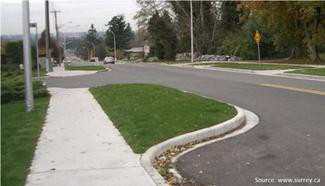 |
Curb Extension: A curb extension (also known as bump out, neckdown, choker, curb bulb, or bulb-out) is a horizontal intrusion of the curb into the roadway resulting in a narrow section of roadway. The curb is extended on one or both sides of the roadway to reduce its width to as a little as 6.0 m for two-lane, two-way traffic. In urban environments, it is possible to implement curb extensions by removing existing parking spaces. |
 |
Raised Median: A raised median island is an elevated median constructed on the centerline of a two-way roadway to reduce the overall width of the adjacent travel lanes. |
 |
Centerline Signage with Edgeline Bollards: The use of vertical treatments such as flexible post-mounted delineators or raised pavement markers to create a centre median. Centerline signage and Edgeline bollards are placed to narrow travel lanes. |
 |
Mini (Neighbourhood) Roundabout: A mini roundabout is an island located at the centre of an intersection, which requires vehicles to travel in a counter-clockwise direction around the island. |
 |
Radar Speed Feedback Sign: A radar speed feedback sign is an interactive sign that displays vehicle speeds as oncoming motorists approach. Vehicle speed is captured using radar and can trigger the display board to show when vehicles approach at predetermined undesirable speeds. |
Road Watch Program for Reporting any Incidents of Speeding and Unsafe Driving
Road Watch is a partnership with Durham Reginal Police Service where residents can confidently report unsafe or aggressive driving.
How to report any incidents of speeding and unsafe driving?
- If you witnessed a driver speeding, behaving aggressively or driving unsafe, use the Road Watch Report Form or the online complaint form found on the Durham Regional Police Road Watch Program web page.
- Record and detail as much information as possible from the incident. Any personal information you provide will be confidential and used for statistical use only. For more information about the Road Watch program, visit Whitby Road Watch web page or check the Durham Regional Police Road Watch Program.
What is a Traffic Calming Policy?
A Traffic Calming Policy is an official document that outlines the basis for initiating a Traffic Calming Study and establishes the criteria for evaluating requests, addressing matters like:
- the locations and types of streets that do and do not qualify for traffic calming;
- the process for completing a Traffic Calming Study; and
- the timing and basis for removal of traffic calming measures after implementation.
The Town’s Traffic Calming Policy applies to the implementation of Traffic Calming measures on Local Roads, Collector Roads, and select Type C Arterial Roads under the jurisdiction of the Town of Whitby. The policy does not apply to roads under the jurisdiction of the Regional Municipality of Durham (Regional Roads), the Province of Ontario (Provincial Highways), or private roads.
How can we make a request for Traffic Calming?
Resident(s) with concerns about speeding and/or shortcutting traffic can request for a Traffic Calming Study for their neighborhood streets by submitting a Traffic Calming Request Form. Once the form is received, Transportation Services staff will follow up with the resident(s) and advise on the next steps. These steps include determining the eligibility of the street for traffic calming measures through screening step, and if the criteria are met, proceeding to the petition process. The Mayor and Councillors can also request studies on behalf of their constituents. Please refer to step-by-step traffic calming process, from request initiation to implementation, as outlined in Request (New) Traffic Calming in Your Neighbourhood.
Why is the Petition Process important?
The petition process is important to confirm that a sufficient number of residents support the traffic calming request before proceeding to the technical assessment and plan development stages. If the petition demonstrates broad community support, it is more likely that the proposed traffic calming plan will also receive support during the neighbourhood survey phase.
How can we make a request for a 40 km/h neighborhood speed limit?
A review for a 40 km/h neighbourhood speed limit is included within the framework of Traffic Calming Process. A separate request is not required. Please refer to the traffic calming process outlined in Request (New) Traffic Calming in Your Neighbourhood.
What if a street has safety concern (e.g., high collision frequency) and does not meet the criteria for traffic calming?
Such matters are reviewed separately and do not require a petition or neighbourhood survey, as required under the Traffic Calming Policy.
Are there any drawback to traffic calming measures?
In some instances, traffic calming can:
- increase emergency vehicle response and transit operating times;
- restrict or impede vehicle access to neighbourhood areas;
- shift traffic concerns to other roadways;
- increase maintenance costs for snow clearing and curbside waste collection; and
- increase vehicle emissions and/or noise pollution.
Careful consideration and proper planning, design, and implementation are key to the success of a traffic calming plan.
What are the criteria for Removal Request of existing traffic calming measures?
For a street with existing traffic calming measures to be eligible for a removal request, the following criteria must be met:
- traffic calming measures must have been installed for at least for three years;
- petition should be signed by at least 30% households indicating support for removal; and
- staff must review the request and determine that removing the traffic calming measures from the subject street would not result in a safety impact.
Subscribe Today!
Our online newsroom makes it easy for you to stay informed. Subscribe and get the information you need, when you need it.


